🎁 New: Build Customer Loyalty & Drive Repeat Purchases with WooCommerce. Learn more



Running a WooCommerce Store in a Low-Trust Payment Environment
There is a version of eCommerce that lives in textbooks — sleek checkout pages, one-click payments, seamless Stripe integrations, and customers who trust you before they’ve even read your about page.
Then there is the version most real-world merchants actually live in.
If you’re running a WooCommerce store in an emerging market — or serving customers who have been burned by online fraud, sketchy sellers, or failed deliveries — you already know that trust is not a given. It is earned, transactionally, one order at a time.

This article is for those merchants. We’ll walk through the fundamentals of running a WooCommerce store, explore what a typical payment environment looks like, and then dig into the specific challenges of operating in a low-trust payment environment, and how you can not only survive it, but thrive.
1. Running a WooCommerce Store — The Fundamentals
WooCommerce is the world’s most widely used eCommerce platform, powering over 28% of all online stores globally. Built as a WordPress plugin, it transforms any WordPress website into a fully functional online store with product listings, cart management, checkout flows, order tracking, and an enormous ecosystem of extensions.
Why Merchants Choose WooCommerce
- Ownership and control: Unlike hosted platforms like Shopify, WooCommerce gives you full control over your store’s data, design, and functionality.
- Flexibility: From digital downloads to physical products, subscriptions to bookings, WooCommerce handles it all.
- Cost efficiency: The core plugin is free. You own your hosting and can scale on your own terms.
- Extensibility: Thousands of plugins and themes let you customize every aspect of the store — including how you accept payments.

The Core WooCommerce Workflow
When a customer visits your WooCommerce store, the typical journey looks like this:
- Browse product listings
- Add to cart and proceed to checkout
- Select a payment method (card, bank transfer, gateway, etc.)
- Complete payment and receive order confirmation
- Merchant fulfills the order and marks it complete
- Customer receives the product or service
Sounds straightforward. And in many markets, it largely is. But the payment step — that third and fourth point in the journey — is where things get complicated in many parts of the world.
2. The Typical Payment Environment in WooCommerce
In a mature eCommerce market (think North America or Western Europe), the payment environment is largely built on card-based infrastructure. Customers carry Visa or Mastercard credentials, payment processors like Stripe or PayPal handle the complexity, and chargebacks act as a consumer protection mechanism.
Standard WooCommerce Payment Methods
Out of the box, WooCommerce ships with support for:
- Direct Bank Transfer — customers pay manually via bank transfer
- Check/Cheque Payments — largely legacy
- Cash on Delivery (COD) — payment at the point of physical delivery
- PayPal — via the built-in PayPal standard integration
Beyond these defaults, the plugin marketplace offers integrations for Stripe, Square, Authorize.Net, Klarna, and dozens of regional gateways.
What Makes a Payment Environment “Functional”
A functional payment environment is one where:
- Customers have reliable access to digital payment tools (cards, mobile wallets)
- Payment processors can verify and settle transactions smoothly
- Both buyer and seller have legal and institutional recourse when things go wrong
- Fraud rates are manageable, and chargeback processes are fair
In such environments, the default WooCommerce setup works beautifully. You install a payment gateway plugin, connect your merchant account, and you’re live.
But what happens when those conditions don’t hold?
3. The Peculiarities of a Low-Trust Payment Environment
A low-trust payment environment is not a technical term — it’s a lived reality for millions of merchants and shoppers across Africa, Southeast Asia, parts of Latin America, and even specific demographics in developed markets.
It describes an ecosystem where the social, institutional, and infrastructural preconditions for smooth digital commerce are fragile or absent.
Defining Characteristics
- Low consumer confidence in online stores; Shoppers have either personally experienced fraud or know someone who has. They are reluctant to pay upfront for a product they haven’t seen, from a seller they can’t physically visit. The digital storefront, no matter how polished, doesn’t confer credibility by default.
- Preference for Pay-on-Delivery; Cash on Delivery remains king in many low-trust markets. Customers want to inspect the goods, confirm the seller is real, and then hand over their money. This puts enormous operational pressure on merchants — you fulfill the order before payment is guaranteed.
- Unreliable or inaccessible payment infrastructure; Card penetration can be low. Bank transfer processes can be slow or opaque. Mobile money solutions (like M-Pesa or MTN MoMo) are growing but not universally supported by standard WooCommerce gateways. USSD-based payments and manual bank deposits remain common.
- High rates of order abandonment and non-payment; In markets where Pay-on-Delivery dominates, merchants frequently experience customers who place orders and never show up to receive or pay for their items. This drives up logistics costs and operational waste.
- Distrust flows in both directions; It’s not just buyers who are skeptical. Merchants are equally wary. Accepting digital payments exposes them to chargebacks, payment reversals, and fraud from buyers who claim non-delivery after receiving goods. So both sides are playing defense.
- Informal verification practices; In the absence of institutional trust, merchants resort to manual verification: calling customers before dispatch, collecting screenshots of payment confirmations, building WhatsApp-based customer relationships, and manually cross-checking bank statements before shipping.

The WooCommerce Problem in Low-Trust Environments
Standard WooCommerce payment plugins are designed for the mature-market model. They assume:
- Customers will pay by card or wallet upfront
- The payment processor will handle verification and fraud screening
- Disputes will be resolved through formal chargeback channels
None of these assumptions holds cleanly in a low-trust environment. The result? Merchants cobble together workarounds — manual order management, offline payment confirmations, Excel spreadsheets tracking who paid and who didn’t — creating operational chaos that scales terribly.
What’s needed is a WooCommerce payment solution built specifically for how business actually works in these markets.
4. Introducing Direct Payments for WooCommerce
This is where Direct Payments for WooCommerce comes in — a plugin designed not for the textbook version of eCommerce, but for the real one.
What Is Direct Payments for WooCommerce?
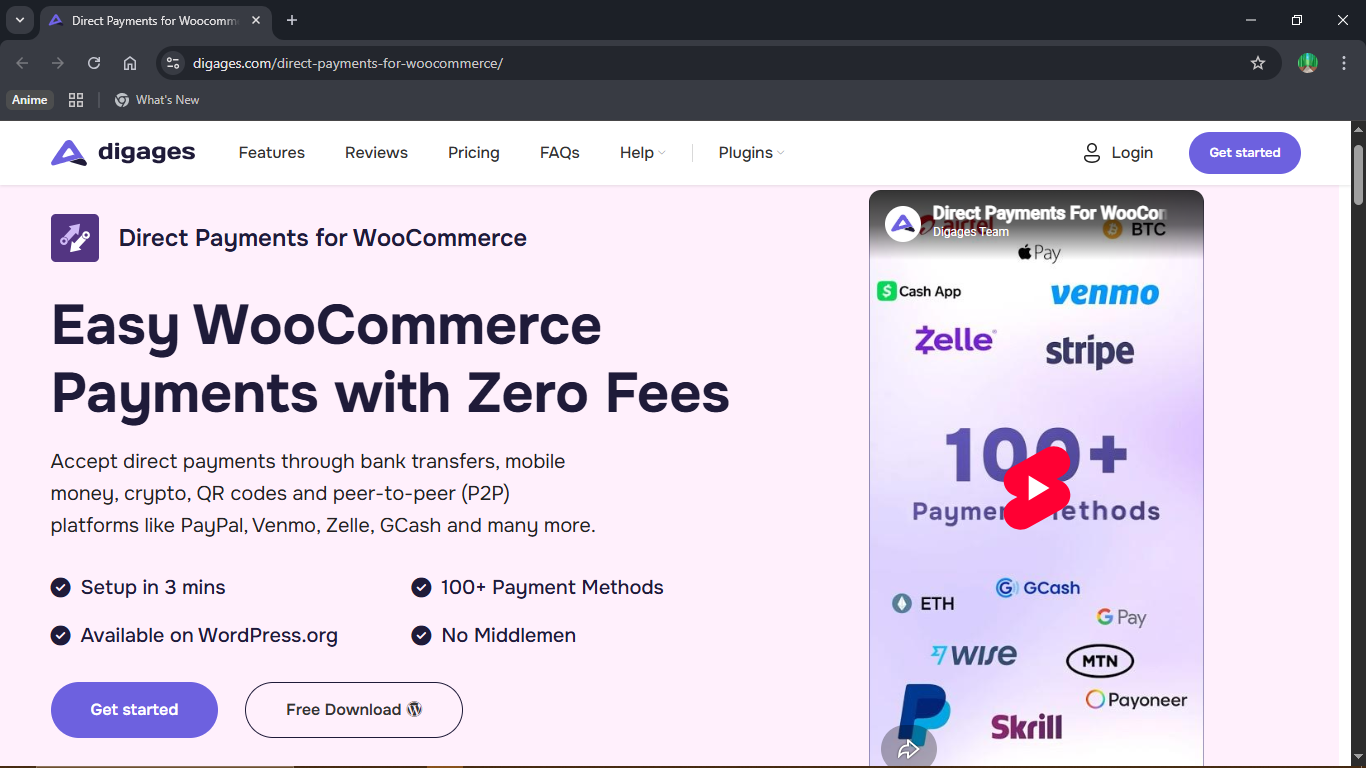
Direct Payments for WooCommerce is a lightweight, powerful plugin that enables merchants to accept direct Bank Transfers, mobile money, and manual payment confirmations natively within WooCommerce — without routing every transaction through a third-party payment gateway.
Rather than forcing customers into a checkout flow that assumes card payment, Direct Payments for WooCommerce meets your customers where they actually are.
Who Is It For?
Direct Payments for WooCommerce is the right tool for:
- Merchants in emerging markets where card infrastructure is limited
- Niche or high-AOV sellers who prefer to confirm payment before shipping expensive items
- B2B WooCommerce stores where invoicing and Bank Transfers are the norm
- Local service businesses running on WooCommerce who need a simple, reliable way to collect payment confirmations
- Any merchant who wants full control over their payment process without gateway dependency
How It Solves the Low-Trust Payment Problem
Supports manual payment methods your customers already use. Whether your customers pay via bank transfer, USSD, mobile money, or any regional payment channel, the plugin captures the payment instructions, keeps the customer informed, and holds the order in a pending state until you confirm receipt.
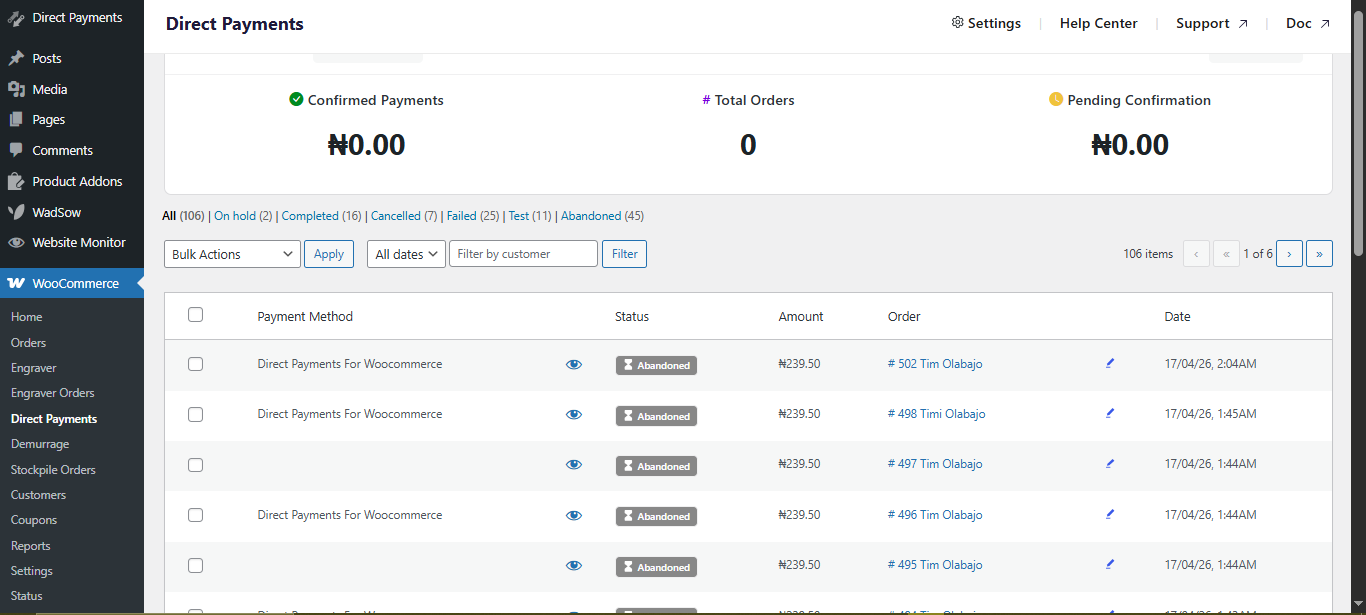
Puts the merchant in control of payment confirmation. No more manually emailing customers or chasing down payment screenshots. The plugin provides a structured flow for merchants to mark orders as paid once they’ve confirmed receipt — reducing errors and eliminating the chaos of informal verification.
Reduces COD risks with structured pre-payment workflows. For merchants trying to move customers from Cash on Delivery to pre-payment, Direct Payments provides a trust bridge: customers can see exactly where and how to pay, and merchants can track outstanding payments without leaving their WooCommerce dashboard.
No monthly fees or percentage cuts. Unlike most payment gateways, Direct Payments for WooCommerce does not take a cut of your transactions. You pay for the plugin, not for the privilege of receiving your own money.
Fully WooCommerce-native. It integrates seamlessly with your existing WooCommerce orders, emails, inventory management, and reporting. No duplicate systems. No learning curve.
Works across any market. Whether you’re selling in New York, Lagos, Nairobi, London, Accra, or Dhaka, Direct Payments for WooCommerce is built to be flexible enough to accommodate local payment realities without requiring a formal merchant account with an international gateway.
5. Building Trust Into Your WooCommerce Store — Beyond Payments
Solving the payment problem is critical, but it’s just one layer of trust-building. Here are a few additional strategies savvy WooCommerce merchants in low-trust environments deploy:
Social proof at every touchpoint — product reviews, customer testimonials, and user-generated content signal to skeptical buyers that real people have purchased from you and been satisfied.
Transparent policies — clear return policies, delivery timelines, and contact information reduce the perceived risk of buying from an unfamiliar store.
WhatsApp and live chat integration — in markets where messaging apps are the primary communication channel, offering real-time support dramatically improves conversion rates.
Order tracking and proactive communication — keep customers in the loop from the moment they place an order to delivery. Uncertainty breeds distrust.
Consistent branding — a polished, professional storefront (even a simple one) signals legitimacy to first-time buyers.

Build for the Market You're Actually In
The default WooCommerce setup is an excellent starting point — but it was built with a certain kind of payment environment in mind. If you’re operating in a low-trust market, you need tools that reflect your reality, not an idealized version of global eCommerce.
Direct Payments for WooCommerce is that tool. It’s practical, flexible, and built for merchants who understand that trust isn’t handed to you — it’s something you build, transaction by transaction, with the right infrastructure underneath you.
The question isn’t whether you can run a successful WooCommerce store in a low-trust payment environment. The question is whether you have the right plugin to do it.
Ready to take control of your WooCommerce payments? Learn more about Direct Payments for WooCommerce and start accepting payments on your own terms.